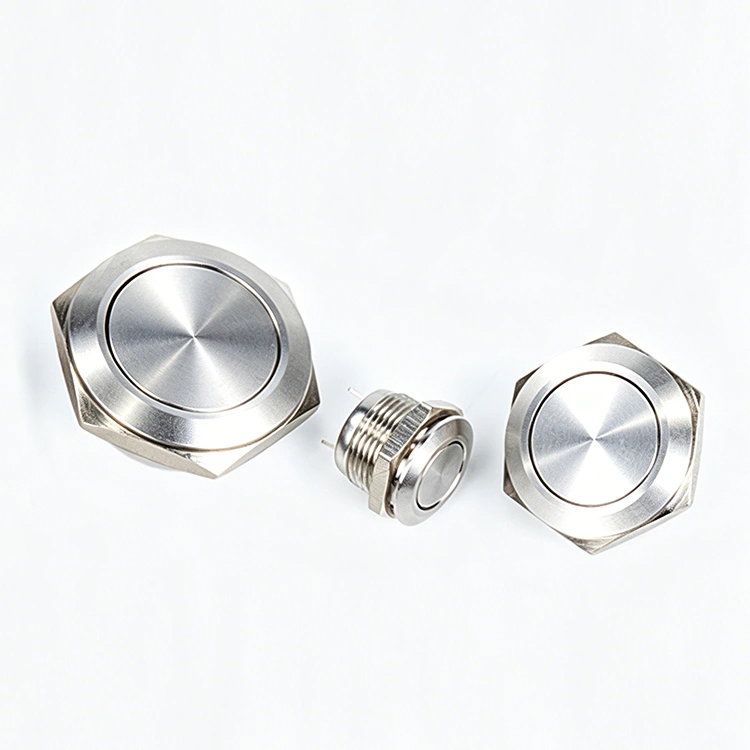
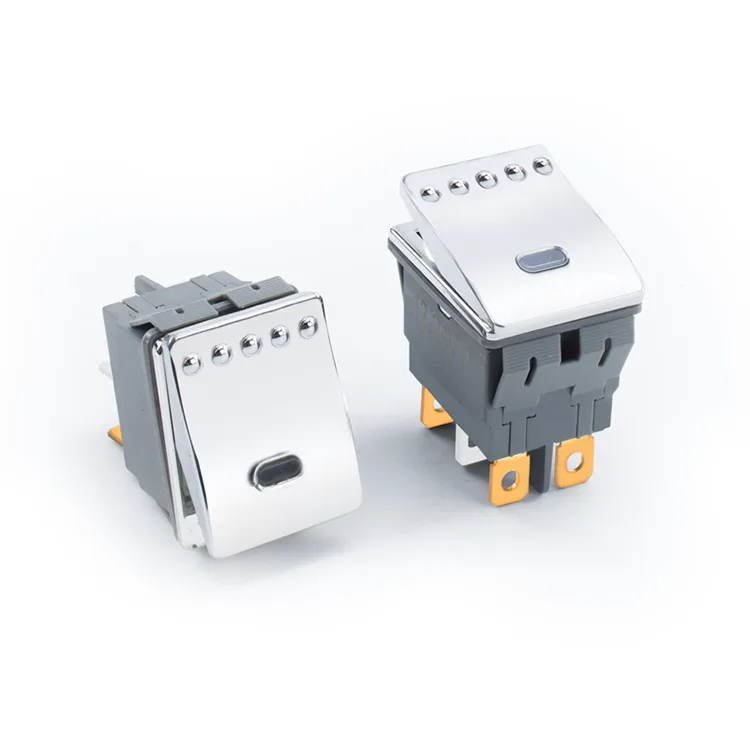
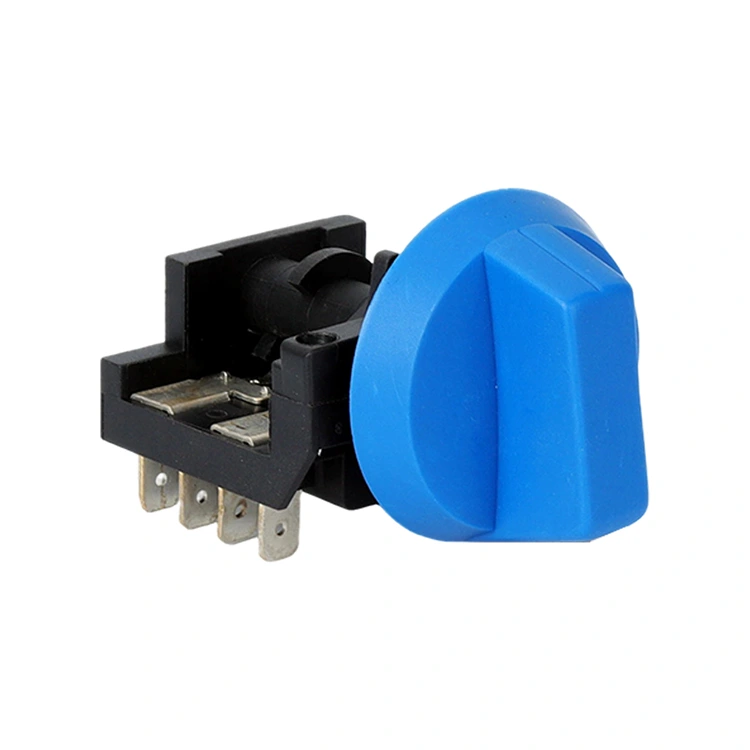
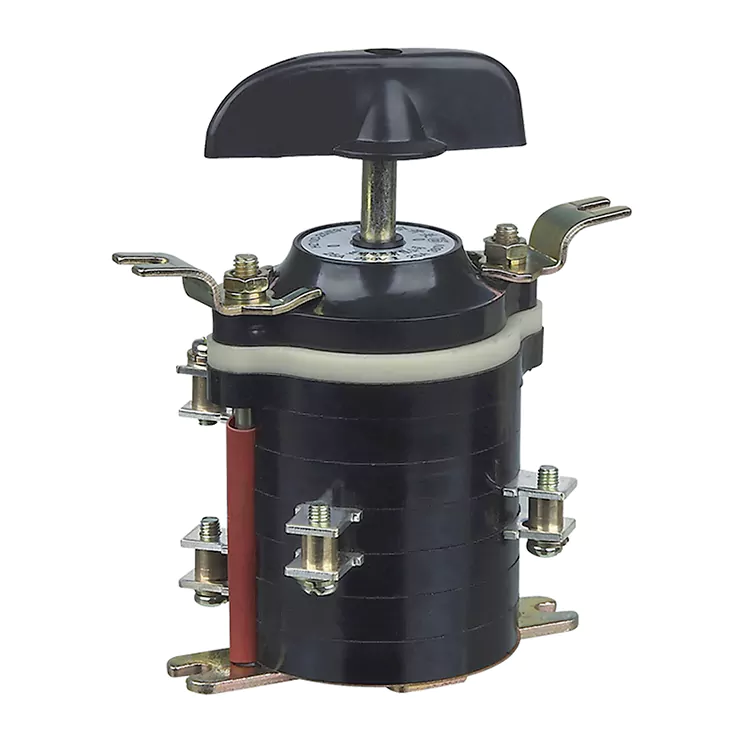
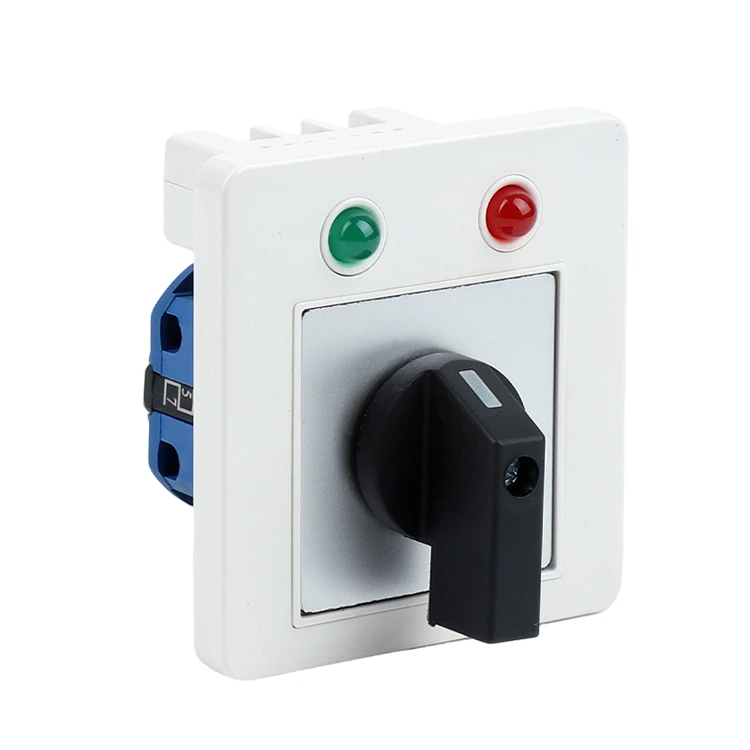
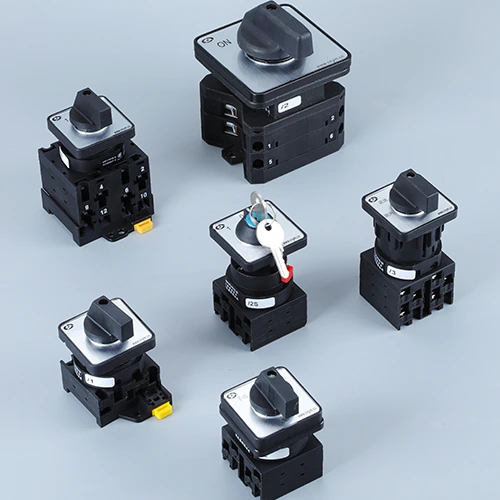
A changeover switch (also known as a combination switch) is a multi-position, multi-contact manual control electrical component, mainly used for switching circuits on/off, power supply switching, signal conversion, or controlling the forward and reverse rotation of motors. Its core feature is that rotation or tossing drives multiple internal sets of contacts to operate synchronously, achieving the switching of different circuit paths. It is widely used in industrial control, electrical equipment, and instrumentation.
II. Core Structure of a Changeover Switch
To understand its working principle, it is necessary to first identify its core components, which work together to achieve the switching function:
Operating Mechanism: An external manual control component (such as a knob or handle) that rotates or tosses an internal shaft. It typically has multiple positions (e.g., 2, 3, 4 positions), each corresponding to a different contact combination.
Contact System: The core functional component, composed of moving and stationary contacts. Each set of contacts corresponds to one circuit path. The moving contact is fixed to the shaft, and the stationary contact is fixed to the terminal block inside the housing. The contact material is often copper alloy (such as silver alloy) to ensure conductivity and wear resistance.
Positioning Device: Typically composed of a spring, steel ball, or cam structure, it is used to fix the operating mechanism in position, preventing accidental operation. When the operating handle is turned to the designated position, the positioning device will lock in place, ensuring stable contact of the contacts. Switching requires overcoming the positioning force to ensure clear position selection.
Housing and Terminals: The housing is made of insulating materials (such as plastic or ceramic) for isolation and protection; the terminals are used to connect external wires, connecting the contact system to the controlled circuit.
III. Core Working Principle of the Changeover Switch The core working principle of a changeover switch is "to selectively connect circuit paths by mechanically driving the contacts to switch on and off." The specific process can be divided into three key steps:
**Operation Trigger:** Manually rotating or tossing the operating handle drives the internal shaft to rotate. At this time, the positioning device will release the current position as the shaft rotates and lock in place at the target position, ensuring proper operation.
Contact switching: As the shaft rotates, the moving contact fixed on the shaft rotates synchronously, making "contact" or "separating" with the corresponding stationary contact:
When the moving contact contacts the stationary contact, the circuit path is closed;
When the moving contact separates from the stationary contact, the circuit path is open;
Synchronous operation of multiple contact groups (e.g., switching three contact groups simultaneously) enables coordinated control of multiple circuits (e.g., simultaneously switching power, signal, and protection circuits).
Circuit switching completed: When the operating handle is at the target position, the positioning device fixes the position, the moving contact and stationary contact are stably in contact, and the controlled circuit is activated according to the preset path, completing the switching.
Key Supplement: Coordination Logic of Multiple Positions and Contacts
The core advantage of a changeover switch lies in its "multiple positions corresponding to multiple contact combinations." For example, a 3-position, 2-group contact changeover switch has different contact on/off states for each position:
Position 1: Contact group 1 is on, contact group 2 is off;
Position 2: Contact group 1 is off, contact group 2 is on;
Position 3: Both contact groups 1 and 2 are on (or both are off, depending on design requirements).
Through this combination, a single operation can control the synchronous switching of multiple circuits, simplifying the control logic.
IV. Classification and Typical Applications of Changeover Switches
Based on structure and application, changeover switches can be classified into different types, with slight variations in their working principles:
Classification by Operation Method:
Rotary Changeover Switch (Most Common): Switches positions by rotating a handle, such as power switches and motor forward/reverse control switches;
Toggle Changeover Switch: Switches positions by toggling a handle, often used in small equipment or instruments.
Classification by contact group number:
* Single-pole changeover switch: Only one contact group, used for single-circuit switching (e.g., simple power on/off);
* Multi-pole changeover switch: Two or more contact groups, used for multi-circuit coordinated switching (e.g., simultaneously switching three-phase power supply using three contact groups).
Typical application scenarios:
* Power switching: Such as switching between main power and backup power in a dual power supply system;
* Motor control: Controlling the forward and reverse rotation of a motor (by switching the power phase of the motor windings);
* Signal conversion: Switching between different measurement signals in instruments (e.g., voltage, current signals);
* Circuit selection: Switching between different operating modes in industrial equipment (e.g., manual/automatic mode).
V. Core Features of Working Principle
Mechanical Interlocking: Contact switching relies entirely on mechanical operation, with no electronic components involved. This results in a simple structure, high reliability, and suitability for harsh environments (such as high-temperature and vibration scenarios).
Synchronous Switching: Multiple sets of contacts operate synchronously, ensuring consistency in multi-circuit switching (e.g., when a motor reverses direction, the power phase and protection circuit switch synchronously).
Gear Locking: The positioning device prevents erroneous switching, ensuring circuit stability, and is particularly suitable for critical control scenarios (such as power system switching).
We use cookies to offer you a better browsing experience, analyze site traffic and personalize content. By using this site, you agree to our use of cookies. Privacy Policy